

Why Does My Skin Still Look Tired? How XERF and LaseMD Ultra Address Different Signs of Aging
You get enough sleep. You invest in quality skincare. You stay consistent with your routine.
Yet when you look in the mirror, something still feels different.
Maybe your jawline isn’t as defined as it used to be. Perhaps your skin looks dull, sunspots are becoming more noticeable, or makeup doesn’t sit as smoothly as it once did.
Often, it isn’t one dramatic change. It’s several smaller changes happening at the same time.
Skin aging affects both its underlying structure and its visible surface. And understanding that difference can help explain why certain treatments improve one concern while leaving another untouched.
This is where two advanced technologies, XERF skin tightening and LaseMD Ultra, offer an interesting approach to facial rejuvenation.
They work differently, target different concerns, and may complement one another when incorporated into a personalized treatment plan.
Why Skin Can Look Older Even When You Take Good Care of It
Skin aging is influenced by two overlapping processes.
The first is intrinsic aging, which involves biological changes that occur naturally over time.
The second is extrinsic aging, which results from environmental exposures, particularly ultraviolet radiation from the sun.
As skin ages, its collagen structure changes. Collagen fibers become increasingly fragmented, and the skin’s ability to maintain firmness and elasticity can decline.
Meanwhile, repeated sun exposure contributes to pigmentation irregularities, fine lines, and changes in skin texture.
These processes explain why someone can experience both loose skin and uneven pigmentation, even though the concerns arise through different mechanisms.
A 2026 scientific review published in Lasers in Surgery and Medicine discusses how changes in dermal collagen contribute to aging and why radiofrequency treatments are being investigated for collagen remodeling.
Read the research: Monopolar Radiofrequency for Dermal Prejuvenation.
The Problem with Treating Only One Aspect of Skin Aging
Imagine you’re concerned about two things: your jawline has become less defined, and years of sun exposure have left uneven pigmentation across your cheeks.
You choose a treatment that primarily addresses pigmentation.
Your skin tone may improve, but the laxity around your lower face could remain.
Now imagine the opposite.
You receive a treatment focused on skin tightening. Your skin may gradually appear firmer, but existing sunspots and textural irregularities may still be noticeable.
Neither treatment has necessarily failed.
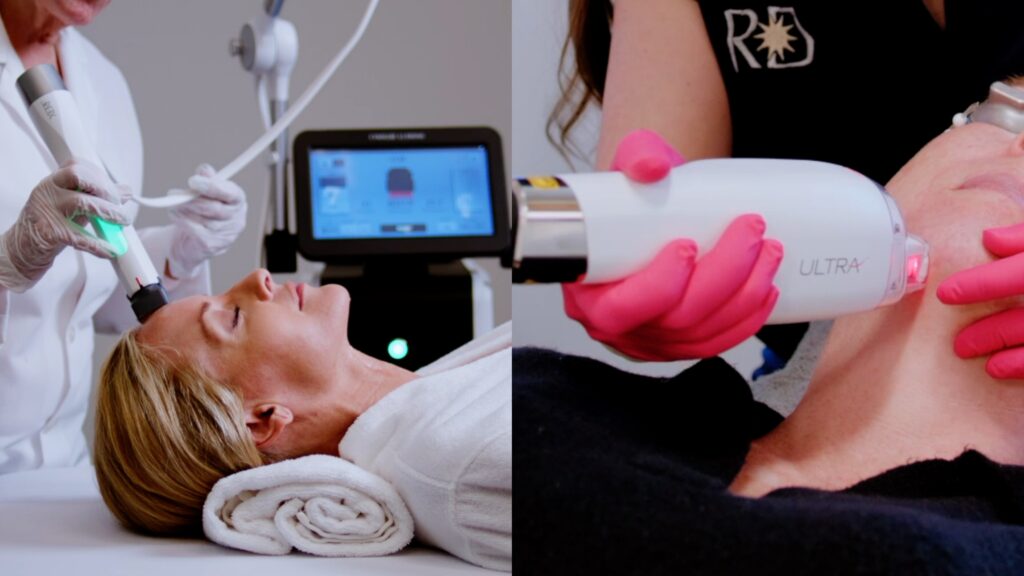
The treatments are simply addressing different concerns.
This distinction is why comprehensive skin rejuvenation sometimes involves more than one technology.
How XERF Works: Addressing Skin Firmness and Laxity
XERF is a non-invasive skin tightening technology that uses monopolar radiofrequency energy.
Unlike lasers, which use light energy, radiofrequency devices generate heat through the interaction of electrical energy with tissue.
Controlled heating can initiate changes in collagen structure and stimulate biological processes involved in tissue remodeling.
XERF uses two radiofrequency frequencies, 6.78 MHz and 2 MHz, along with adjustable treatment depths and intensity settings.
Its integrated cooling system helps manage skin-surface temperature during treatment.
According to Cynosure Lutronic’s official XERF information, these features allow providers to customize energy delivery according to the treatment area and patient needs.
What Happens to Collagen During Radiofrequency Treatment?
Collagen is one of the primary structural proteins responsible for skin strength.
When collagen-rich tissue is exposed to controlled thermal energy, existing collagen can undergo structural changes. The subsequent tissue response may also involve new collagen formation.
These processes are often described as collagen remodeling and neocollagenesis.
They provide the scientific rationale for using monopolar radiofrequency technology to improve the appearance of skin laxity.
Research on monopolar radiofrequency supports its potential to improve skin firmness, although results vary by device, treatment settings, and individual characteristics.
XERF may be considered for concerns such as reduced skin firmness around the lower face, changes in jawline definition, and laxity involving the neck.
However, XERF is not a substitute for surgical lifting in patients with substantial tissue sagging.
Learn more about XERF Skin Tightening at VIV Life Lounge.
How LaseMD Ultra Works: Addressing Pigmentation and Skin Texture
Now consider the skin’s visible appearance.
Even when facial contours remain relatively firm, sun damage and changes in texture can affect how youthful and even the skin looks.
LaseMD Ultra addresses a different set of concerns.
Ultra is a 1927-nanometer non-ablative fractional thulium laser.
It delivers laser energy into microscopic treatment zones rather than removing the entire outer surface of the skin.
The 1927 nm wavelength is strongly absorbed by water-containing tissue, allowing controlled treatment of relatively superficial skin layers.
This fractional approach stimulates skin renewal and remodeling while leaving surrounding areas untreated.
What Can LaseMD Ultra Help Improve?
LaseMD Ultra is used for concerns including uneven pigmentation, visible sun damage, age spots, fine lines, and irregular skin texture.
The manufacturer’s Ultra technology information describes its applications for improving tone and texture.
Clinical research also supports the use of 1927 nm fractional thulium lasers for selected photoaging concerns.
For example, a 2023 prospective study involving 27 participants evaluated three treatments with a non-ablative 1927 nm thulium laser.
Researchers reported improvements in several measured skin characteristics, including pigmentation-related measures, wrinkles, and elasticity.
Although the study was relatively small and did not establish outcomes for every device or skin type, it provides clinical evidence supporting the broader technology.
Read the published study: Efficacy and Safety of a 1927 nm Fractional Thulium Laser in Photoaging.
Why XERF and LaseMD Ultra May Work Well Together
The appeal of combining these technologies comes from their different treatment mechanisms.
XERF uses radiofrequency energy to address skin firmness and laxity.
LaseMD Ultra uses fractional laser energy to address concerns involving pigmentation, texture, and visible sun damage.
Together, they offer a way to consider both structural and surface-related changes in skin appearance.
What Does the Research Say About Combining These Technologies?
A 2025 study published in Dermatologic Surgery examined a combination of monopolar radiofrequency and non-ablative fractional laser treatments.
The study involved 20 women with mild-to-moderate facial laxity and photoaging.
Participants received a monopolar radiofrequency treatment followed by a series of fractional laser treatments.
At six months, researchers observed improvements in measures of skin laxity and photoaging.
Read the study: Combination Use of Nonablative Fractional Laser With Monopolar Radiofrequency.
This research supports the rationale for addressing multiple signs of aging through complementary technologies.
However, the study used Thermage FLX and Clear + Brilliant Touch, not XERF and LaseMD Ultra.
Therefore, its findings cannot be used to promise identical outcomes with XERF and Ultra.
Direct clinical evidence evaluating the specific XERF and LaseMD Ultra combination remains limited.
The distinction matters because a scientifically reasonable treatment combination is not the same as a clinically proven superior combination.
Do You Need Both Treatments?
Not necessarily.
Someone whose primary concern is skin laxity may be better suited to XERF alone.
Someone experiencing uneven pigmentation or texture, without significant laxity, may benefit from LaseMD Ultra without needing radiofrequency skin tightening.
However, when both types of concerns are present, a combined treatment plan may be worth considering.
The appropriate approach depends on your skin condition, medical history, goals, and the provider’s assessment.
More treatments do not automatically mean better results. The objective is to select the treatments that address your actual concerns.
Can XERF and LaseMD Ultra Be Performed on the Same Day?
For appropriately selected patients, both technologies may be incorporated into the same appointment.
However, the decision should be made by a qualified provider after evaluating the treatment areas, planned energy settings, recent procedures, and individual risk factors.
Both radiofrequency and fractional laser treatments involve controlled energy delivery to the skin.
Temporary redness, swelling, sensitivity, and other reactions may occur. Fractional laser treatment also carries risks such as post-inflammatory hyperpigmentation, particularly in susceptible patients.
A 2026 review of fractional laser treatments in skin of color found that pigmentation-related risks vary with treatment parameters and emphasized careful selection of settings.
Read the review: Fractional Laser Treatment in Skin of Color.
There is no universally appropriate same-day protocol for every patient.
Careful screening and individualized treatment planning are essential.
When Will You Notice Results?
Because XERF and LaseMD Ultra work through different mechanisms, their visible effects may develop on different timelines.
With radiofrequency skin tightening, some individuals notice an early improvement in firmness, while collagen remodeling can continue over subsequent weeks and months.
With fractional laser treatment, changes in pigmentation and texture may become more apparent as the skin recovers and renews.
Multiple sessions may be recommended depending on the treatment plan and the concerns being addressed.
Results are influenced by skin condition, treatment settings, age, sun exposure, and individual healing responses.
Neither technology can stop aging, and neither guarantees a particular degree of improvement.
Why Skin Rejuvenation Should Begin with a Consultation
One of the most important parts of aesthetic treatment planning is identifying what is actually contributing to the concern.
A patient may describe their skin as looking tired, but that description can refer to several different issues.
It might involve reduced skin firmness, uneven pigmentation, changes in texture, volume loss, or a combination of factors.
These concerns do not all respond to the same treatments.
A consultation allows a provider to evaluate skin quality, discuss goals, review relevant medical history, and determine whether XERF, LaseMD Ultra, or another approach is appropriate.
This is particularly important for individuals with a history of melasma, post-inflammatory hyperpigmentation, recent cosmetic procedures, or other factors that may influence treatment selection.
A Comprehensive Approach to Skin Rejuvenation at VIV Life Lounge
At VIV Life Lounge in Millburn, New Jersey, we offer both XERF skin tightening and LaseMD Ultra as part of our advanced aesthetic services.
We’ve also introduced K-LUXE, our customized skin rejuvenation protocol that brings these two technologies together.
K-LUXE is designed around a simple principle: address skin structure and surface concerns as part of one thoughtful treatment plan.
For some patients, that may involve XERF and Ultra during the same visit. For others, a staged approach or a single technology may be more appropriate.
Our goal is to help patients understand their options and develop a treatment plan based on their individual skin concerns.
We welcome patients from Millburn, Short Hills, Summit, Livingston, Maplewood, and surrounding North Jersey communities.
The Bottom Line: Better Skin Starts with Understanding What Needs Improvement
When your skin looks tired, dull, or less defined, the solution isn’t always another skincare product or a treatment targeting only one concern.
Sometimes, the changes you’re noticing involve both the skin’s underlying structure and its visible surface.
XERF and LaseMD Ultra work through different mechanisms, which is why they may complement one another in an individualized rejuvenation plan.
XERF addresses firmness and laxity. LaseMD Ultra addresses tone, texture, and visible sun damage.
Understanding the difference is the first step toward choosing an appropriate treatment.
Interested in exploring XERF, LaseMD Ultra, or our K-LUXE protocol?
Schedule a consultation at VIV Life Lounge to discover which approach may be right for your skin.
VIV Life Lounge
44 Main Street, Suite 3
Millburn, NJ 07041
973-788-5146
www.vivlifelounge.com
Scientific References
- Kilmer SL, et al. Monopolar Radiofrequency for Dermal Prejuvenation: Scientific Rationale and Mechanisms of Action. Lasers in Surgery and Medicine. 2026.
https://pubmed.ncbi.nlm.nih.gov/41456098/ - Cynosure Lutronic. XERF: Structural Skin Tightening. Official manufacturer technology information.
https://www.cynosure.com/xerf/ - Cynosure Lutronic. Ultra 1927 nm Thulium Laser. Official manufacturer technology information.
https://www.cynosure.com/product/ultra/ - Li X, et al. Prospective Study of Efficacy and Safety of Non-Ablative 1927 nm Fractional Thulium Fiber Laser in Asian Skin Photoaging. Frontiers in Surgery. 2023.
https://pubmed.ncbi.nlm.nih.gov/36950052/ - Peters JD, et al. Combination Use of 1440-nm and 1927-nm Nonablative Fractional Laser With Monopolar Radiofrequency for the Treatment of Facial Skin Laxity, Skin Texture, and Pigmentation. Dermatologic Surgery. 2025.
https://pubmed.ncbi.nlm.nih.gov/39964075/ - Goldman MP, et al. Dual 1550-nm Erbium Glass Fiber and 1927-nm Thulium Fiber Non-ablative Fractional Laser System Treatment in Patients With Skin of Color: A Review of Clinical Studies and Unmet Needs. Lasers in Surgery and Medicine. 2026.
https://pubmed.ncbi.nlm.nih.gov/41668543/
